
Thermal Break Aluminium Windows: How Polyamide Cuts U-Values
Technical Guides · 2026/10/21 · 43 views
Understand how thermal break technology reduces window U-values to 1.2 W/m²K. Compare polyamide barrier widths, energy savings, and thermal bridge reduction.
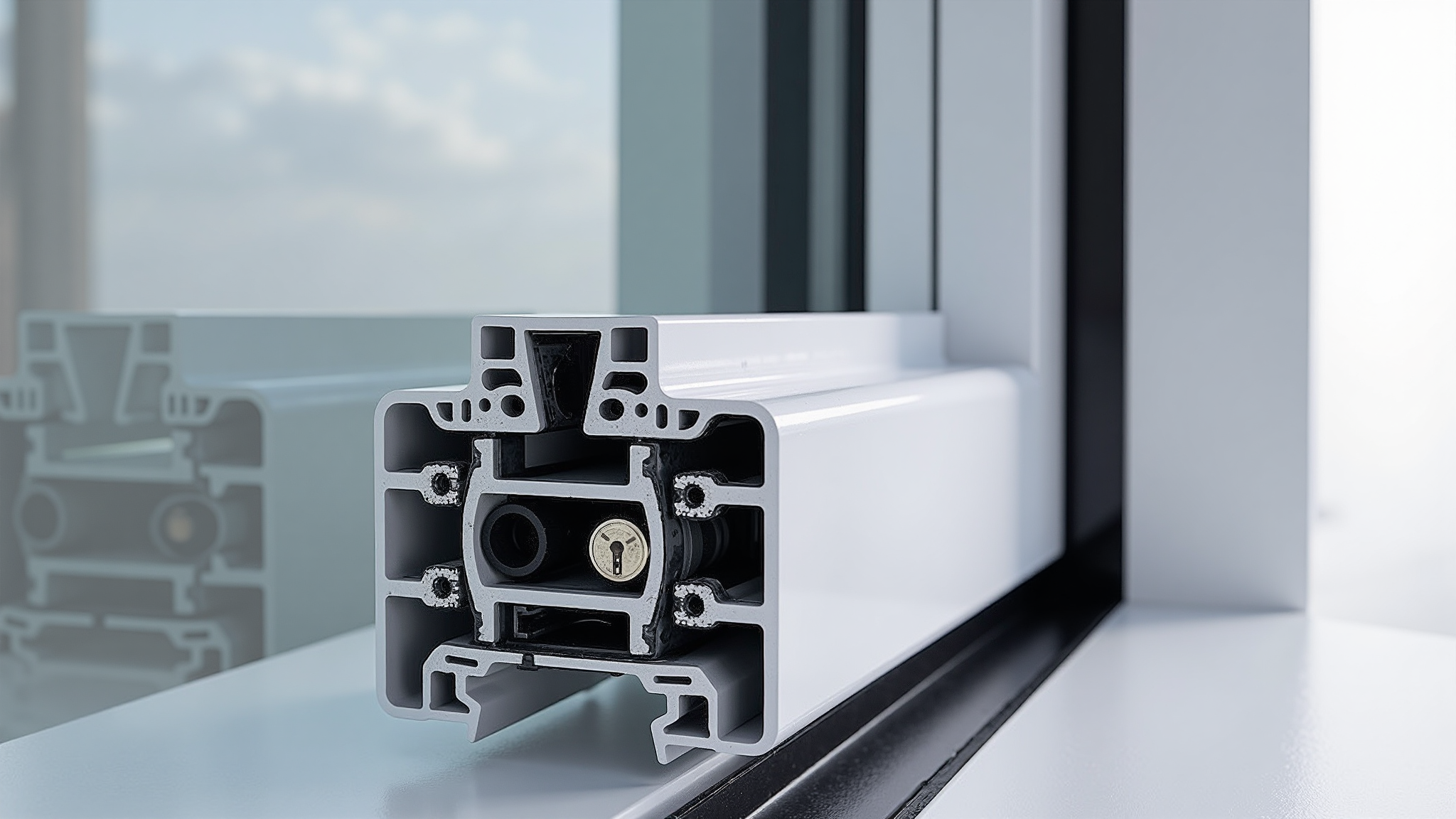
Short answer: Thermal break aluminium windows place a polyamide PA66 strip between the inner and outer aluminium profiles, breaking the conductive path through the frame. That change takes a window from the 5.0–6.0 W/m²K typical of standard aluminium to 1.5–2.5 W/m²K, and multi-chamber profiles with Low-E triple glazing reach 0.8–1.6 W/m²K.
Key takeaways
- Polyamide PA66 conducts far less heat than aluminium, so the strip interrupts the heat path without losing structural continuity.
- U-value is measured on the complete window, so a frame claim without its glazing package is not a U-value.
- Passive House certification requires 0.8 W/m²K or lower for the installed window, verified on a certified component.
- Ask for reports naming ASTM E283, ASTM E331 and a structural class, not a marketing U-value alone.
- Lead time is 20–30 days after drawing approval, with a 5-year manufacturer warranty on every system.
What a Polyamide Thermal Break Strip Does Inside the Profile
Aluminium is structural and it also conducts heat efficiently, so a single-wall frame forms a continuous bridge between a warm interior and a cold exterior. Condensation on the interior face is the visible symptom; heat leaving through every metre of frame is the invisible one.
A thermal break interrupts that path. The profile is extruded in two sections, and a polyamide PA66 strip is crimped or rolled into both, locking the halves together. PA66 conducts far less heat than aluminium, so the halves are thermally separated while the frame keeps its structural continuity and fixing points.
The strip carries structural load, which is why its width and the quality of the crimp matter more than any datasheet claim. A break that is too narrow, or a crimp that loosens under repeated thermal cycling, produces a frame that reads well in a sample and leaks heat on site after two winters.
Where the U-Value Comes From: Frame, Glass and Spacer
U-value is an area-weighted average, not a single material property. A window figure is calculated from the frame, the edge-of-glass zone and the centre of glass, each weighted by its share of the opening. Two suppliers can therefore quote identical glass and publish different whole-window numbers, because their frame-to-glass ratios differ.
Centre-of-glass performance comes from the insulating glass unit: Low-E coating, cavity width, argon or krypton fill and pane count. Frame contribution comes from the thermal break, the chamber count and the gaskets. The edge zone is set by the spacer, at the most condensation-prone part of the window.
NFRC labels publish U-factor for the whole assembly rather than for the glass alone, which is what a specifier should compare. The Efficient Windows Collaborative tool tests the trade-off between U-factor, SHGC and visible transmittance before a build-up is frozen, and ASHRAE 90.1 sets the envelope baseline behind most commercial compliance paths.
Thermal Break Aluminium Windows: Three Build-Up Levels
The three levels below cover almost every enquiry that reaches a factory, from internal partitions to certified Passive House housing. U-values are the figures published for this guide; condensation resistance and relative cost are comparative, because both follow the glazing package and the opening size.
| Typical U-value W/m²K | Chamber structure | Condensation resistance | Relative cost | Typical application |
|---|---|---|---|---|
| Standard aluminium: 5.0–6.0 | Single-wall hollow profile, no strip | Low; cold-frame condensation | Baseline | Internal partitions, stores |
| Single thermal break: 1.5–2.5 | One PA66 strip, one or two air chambers | Moderate; warm-edge spacer helps | Mid | Residential, temperate climates |
| Multi-chamber: 0.8–1.6 | PA66 strip plus three or more chambers | High; face stays above dew point | Highest per m² | Cold-climate housing, Passive House, LEED |
| Passive House target: 0.8 or lower | Set by the certified component | High; components are certified for it | Premium | Certified Passive House projects |
Read the table downwards as diminishing returns. The step from no break to a single break leaves the 5.0–6.0 band entirely; the step to multi-chamber is smaller in absolute terms and costs more per square metre, yet it buys certification headroom.
Glass, Spacer and Gasket Choices That Decide the Final Number
A thermal break frame is only half of the assembly. Double glazing with a Low-E coating and an argon fill is the common commercial baseline, and triple glazing with a warm-edge spacer is what carries a window into the lower part of the 0.8–1.6 W/m²K range. Adding chambers to a profile while keeping a basic double-glazed unit leaves most of the improvement unused.
Air movement matters as much as conduction. Multi-seal EPDM gaskets and controlled drainage keep the cavity dry and hold the assembly at ASTM E283 Class 4 air permeability. Hardware rated to 100,000 cycles keeps the compression those gaskets depend on, because a sash that no longer pulls tight turns a good U-value into a draught.
Two products cover most enquiries: the thermal break aluminium tilt and turn window for double-glazed residential and hotel work, and the thermal break aluminium casement window where a narrower sightline is wanted.
Test Data to Verify Before Ordering
A U-value on a quotation is a claim; a test report is evidence. Request reports naming a method, a specimen and a result, because those are the documents a certifier accepts.
- Whole-window U-factor to NFRC procedures, with glazing build-up and spacer identified.
- Air permeability to ASTM E283 Class 4, and water penetration to ASTM E331 Class 5A at 600 Pa.
- Structural wind load to Class C5 up to 4500 Pa on exposed sites.
- Acoustic performance of STC 38–48 dB on sites facing road, rail or airport noise.
- System certificates: CE M.2024.206.C110024, NFRC FWW-M-1, NFRC GDD-M-10, Miami-Dade NOA 26-0311.01 and AS 1288 for glass safety.
Match each certificate to the product family ordered, not to the brand. The OPPGATE certification library is organised that way, supported by in-house glass processing, six testing instruments and 80+ machines in a 20,000 m² plant. Buyers running their own brand route the same evidence through the OEM and ODM programme, which keeps reports in the buyer's name.
Where Thermal Breaks Stop Paying: Climate and Retrofit Limits
The counter-case is worth stating plainly. In a mild climate with a small window-to-wall ratio, a single thermal break usually captures most of the available saving, and the premium for a multi-chamber system can exceed the energy it recovers. Unheated spaces and internal partitions rarely justify a break at all.
Retrofit is limited by geometry before budget. A deeper multi-chamber profile needs a deeper rebate, and replacing frames in an existing wall often costs more in making good than in the windows. Where the wall cannot take a deeper frame, improving glass and gaskets on a single-break profile is the realistic option.
Certification schemes decide whether the extra step is needed. Passive House requires 0.8 W/m²K or lower on the installed window, which is why cold-climate projects specify the multi-chamber build-up. LEED works differently: credits follow modelled whole-building performance, so a single-break frame can still reach the target when glazing and shading do the work. The cold-climate and Passive House range exists for the first case.
Frequently asked questions
What U-value do thermal break aluminium windows achieve?
A single polyamide break typically brings a window to 1.5–2.5 W/m²K, against 5.0–6.0 W/m²K for standard aluminium. Multi-chamber profiles with Low-E triple glazing reach 0.8–1.6 W/m²K across the OPPGATE range, and the exact figure depends on glazing build-up and frame-to-glass ratio.
What U-value do I need for a Passive House project in Canada?
Passive House certification requires 0.8 W/m²K or lower for the installed window, and cold-climate certification is stricter still. Specify a certified component with a warm-edge spacer, and confirm the certificate covers frame, glazing and spacer as one unit rather than the frame alone.
Does a thermal break stop condensation on the frame?
It reduces condensation by keeping the interior surface above dew point, but it does not eliminate the risk. Indoor humidity, air leakage and spacer temperature matter, so a multi-chamber profile with a warm-edge spacer and Class 4 air tightness is the combination that performs.
Is a wider thermal break always better?
No. Wider strips improve the frame U-value with diminishing returns while adding depth, weight and cost. Once the frame sits below the glass contribution, further widening buys little, and upgrading glazing, spacer or air seals pays more than another two millimetres of polyamide.
Do thermal break windows earn LEED credits?
Not on their own. LEED credits follow modelled whole-building energy performance, daylight quality and material transparency, so a window contributes through the simulation, not through a product certificate. Document U-factor, SHGC and air leakage in the model and keep test reports for the credit file.
What lead time and warranty come with an OPPGATE order?
Production takes 20–30 calendar days after drawing approval, or roughly 35 days where custom extrusion or RAL colour matching is required. Every system carries a 5-year manufacturer warranty, and shipments load from Dalian, Qingdao or Tianjin under FOB, CIF, CFR, DDP or EXW terms.
Next step: send a window schedule, CAD DWG or PDF elevation to karen@oppgates.com, or request a technical quotation. OPPGATE quotes within 24–48 hours and produces in 20–30 days after drawing approval.